
- 16.09.2026
- Kategorie Literaturwissenschaft Geschichte / Archäologie
An eleven-year-old errand boy as an invisible actor
von Nachhallende Netzwerke / Resonating Networks
Find of the month: September 2026
by Eline Elmiger
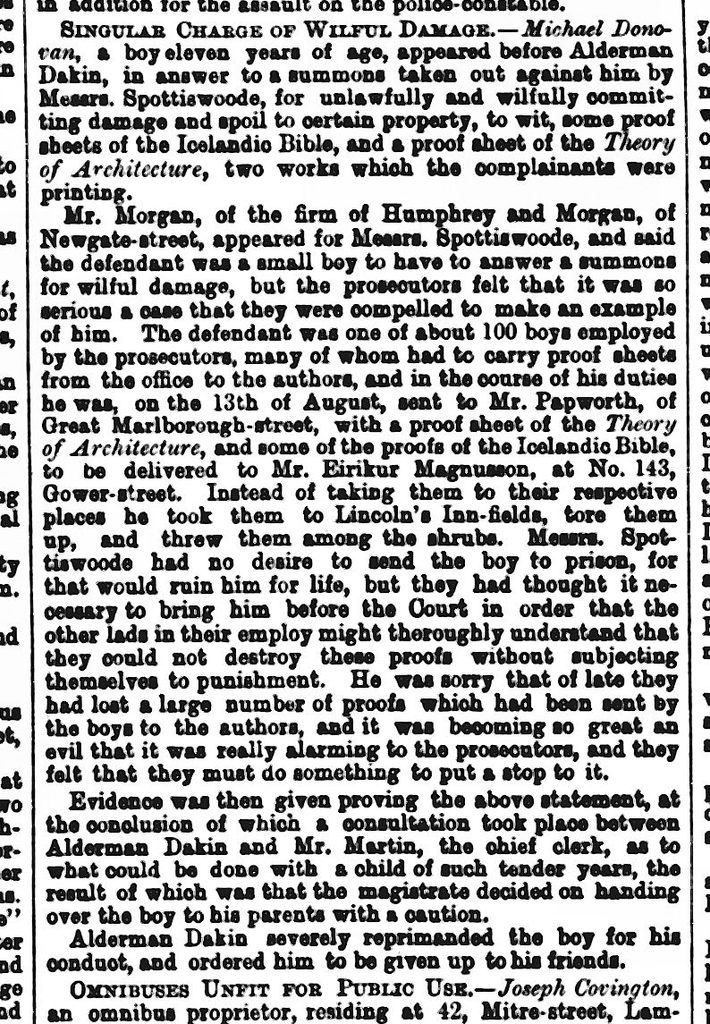
On 13 August 1866, an eleven-year-old errand boy named Michael Donovan was sent across London with proof sheets to deliver. But somewhere near Lincoln’s Inn Fields, he tore the proofs to pieces and threw them into the shrubbery, and three weeks later found himself in front of the court.
Singular Charge of Wilful Damage: Michael Donovan, a boy eleven years of age, appeared before Alderman Dakin, in answer to a summons taken out against him by Messrs. Spottiswoode, for unlawfully and wilfully committing damage and spoil to certain property, to wit, some proof sheets of the Icelandic Bible, and a proof sheet of the Theory of Architecture, two works which the complainants were printing.
Mr. Morgan, of the firm of Humphrey and Morgan, of Newgate-street, appeared for Messrs. Spottiswoode, and said the defendant was a small boy to have to answer a summons for wilful damage, but the prosecutors felt that it was so serious a case that they were compelled to make an example of him. The defendant was one of about 100 boys employed by the prosecutors, many of whom had to carry proof sheets from the office to the authors, and in the course of his duties he was, on the 13th of August, sent to Mr. Papworth, of Great Marlborough-street, with a proof sheet of the Theory of Architecture, and some of the proofs of the Icelandic Bible, to be delivered to Mr. Eirikur Magnusson, at No. 143, Gower-street. Instead of taking them to their respective places he took them to Lincoln’s Inn-fields, tore them up, and threw them among the shrubs.
Messrs. Spottiswoode had no desire to send the boy to prison, for that would ruin him for life, but they had thought it necessary to bring him before the Court in order that the other lads in their employ might thoroughly understand that they could not destroy these proofs without subjecting themselves to punishment. He was sorry that of late they had lost a large number of proofs which had been sent by the boys to the authors, and it was becoming so great an evil that it was really alarming to the prosecutors, and they felt that they must do something to put a stop to it.
Evidence was then given proving the above statement, at the conclusion of which a consultation took place between Alderman Dakin and Mr. Martin, the chief clerk, as to what could be done with a child of such tender years, the result of which was that the magistrate decided on handing over the boy to his parents with a caution.
Alderman Dakin severely reprimanded the boy for his conduct, and ordered him to be given up to his friends.
Spottiswoode’s solicitor did not want the boy imprisoned – that, he said, “would ruin him for life” – but proofs had lately been going missing too often, and the firm wanted the other boys to take note. Alderman Dakin reprimanded Donovan severely and sent him home to his parents with a caution.
Donovan was one of roughly a hundred boys Spottiswoode employed to carry proofs on foot between the printing office and its authors, a detail the firm’s own solicitor mentions in passing. It needed no further comment, because in 1866, children this age or much younger working full days was standard. The major laws of the period regulated some industries like textiles, chimney sweeping or mining, but errand and messenger work fell outside them entirely, and compulsory schooling was still four years away. It is only because this particular errand failed that Donovan appears in the record at all; the other boys, doing the same work correctly every day, left no trace whatsoever.
Seen through Bruno Latour’s actor-network theory, that asymmetry is the interesting part. A network, here, the chain that gets paper from printer to author and back, is made up not just of the named parties, but of everyone and everything that has to hold together for the delivery to succeed: the boy, his route, the paper itself. Normally this labour is a black box, invisible by design, but here, it gets noticed because it failed.
Donovan was carrying proofs to two addresses. One, of the Theory of Architecture, was bound for a Mr. Papworth. The other, of the Icelandic Bible, was addressed to Eiríkur Magnússon at 143 Gower Street. By 1866, Eiríkur had been in London four years, sent from Iceland by the Icelandic Bible Society to work on a revised Icelandic Scripture translation. The proofs Donovan destroyed belonged either to the second, revised edition of that Bible project, or a direct reprint of the first edition of 1863, both of which were published in 1866. In the same year, he published the second volume of the Icelandic Legends together with George E. J. Powell, the translation at the centre of my own dissertation. Even though the torn proof sheets probably didn’t change much about the publication process, they make one usually invisible actor visible to us 160 years later, and hopefully didn’t “ruin him for life.”