
- 03.07.2026
- Kategorie Mediävistik Literaturwissenschaft Forschung im Fokus
Bibliophile practices and networks. Librarians in times of conflict and war
von Nachhallende Netzwerke / Resonating Networks
Find of the month: July 2026
by Lena Rohrbach
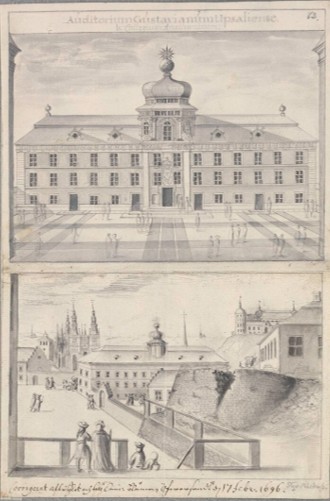
https://commons.wikimedia.org/wiki/File:Suecia_antiqua_(SELIBR_18035901)-1.tif
The first comprehensive catalogues of Scandinavian libraries and book collections were written in the latter half of the seventeenth and the first decades of the eighteenth century, in a time during which the competition between the Danish and the Swedish kingdoms for hegemony in the North reached its apex, with a series of Northern wars between 1655 and 1721. The catalogues of libraries and archives such as Uppsala university library, the Swedish Royal Archive of Antiquities (Antikvitetsarkivet) in Stockholm, the Danish Royal Library, or Árni Magnússon’s book collection, but also of prominent private book collections such as those of Peder Resen or Frederik Rostgaard, all connect and contribute one way or another to this discourse and struggle for political hegemony in the two realms, while at the same time all connecting to and inscribing into international new trends of catalogue making in this period, as established by the French librarian Gabriel Naudé and others, as discussed in a previous find of the month (November 2025).
While all using the same models and adapting them to their own needs, these developments took place independent from each other in the two countries, and each of the catalogues finds an individual solution that reflects a particular position in the Nordic debate of the time. Let us look at two examples: The first systematic catalogue of the philosophical library of Uppsala university library was finalised and systematized by Erik Benzelius the younger during his time as director of the library in the period 1702 to 1724 (today archived as Uppsala UB Bibl. Arkiv K 16-19). We know that Benzelius was well acquainted with current fashions of catalogue making, as he stayed several years in Paris, where he studied library holdings and catalogues. In his catalogue, Benzelius presents works on Swedish and Danish-Norwegian-Icelandic-Greenlandic history separated from each other, with Sweden taking the lead position. The Gothicist framing and legitimation of the Swedish realm is reflected in the description of the Swedish historiography as «Historici Svecici, Goth. Vandal: Longobard: Finn: Livon: Esthon:».
More or less at the same time, in 1726, the previous Danish secret archivist and royal secretary Frederik Rostgaard published a catalogue of his private book collection in connection with a planned auction. Like Benzelius, also Rostgaard spent a longer period in Paris and is known to have studied library holdings and catalogues there. He furthermore contributed actively to the current debate on the structure of library catalogues with the monograph “Projet d’une nouvelle methode pour dresser le catalogve d’une bibliotheqve” in 1698. Different from Benzelius, Rostgaard does not separate between Danish and Swedish historiography in his catalogue, but subsumes both traditions under «Historici Recentiores» for printed books and “Libri Manuscripti Historiam et Antiquitates Regnorum Septentrionalium illustrantis” for his manuscripts. One might conclude that he does not take a stance for Danish hegemony, but rather views the historiographic tradition of the different regions of the North as belonging together, thus reflecting a pan-Nordic position of sorts.
Little surprisingly during times of conflict and wars, we cannot find any trace of exchange between Danish and Swedish libraries, librarians and bibliophiles on librarian matters in this period. There are no copies of Danish library catalogues of this period in the Swedish libraries or the other way around, and there does not seem to have taken place any direct communication between libraries in Denmark and Sweden, or between librarians, archivists and book collectors. Again, this finding is to be expected in times of hostilities between two countries.
We do however find traces of indirect contact between central individuals in the Danish and Swedish bibliophile milieu during the time of the Great Northern war between 1700 and 1721. Erik Benzelius and Frederik Rostgaard communicated with each other aided and mediated by the Swedish-German lieutenant and peace broker Adolf Friedrich von Bassewitz. In a letter to Frederik Rostgaard on 7 July 1719, Bassewitz informs him about Benzelius: »Il souhaitte que la Paix et la tranquillité puissent retablir un commerce litéraire entre deux Nations si voisines, et qui pourroient se donner des lumiéres réciproques sur bien des matiéres, que les tenébres de l’antiquité enveloppent encore.« [He hopes that peace and tranquility may restore a literary exchange between two such close nations—nations that could shed mutual light on many subjects still shrouded in the darkness of antiquity.] And Rostgaard replies some months later to Bassewitz on 18 March 1720: »Je prie Dieu de seconder tous les soins que vous prenez en travaillant å renouér les noeuds d’amitié entre deux Nations, qui par mille raisons devroient toujours s’entreaimer.» (1) [I pray to God to bless all the efforts you are making to renew the bonds of friendship between two nations that, for a thousand reasons, ought always to cherish one another.] Thus, while each following in different ways their own – and/or the respective political-institutional – rationale in the making of their catalogues, these indirect exchanges between two prominent intellectual figures in the two realms reflect a mutual agreement that a close contact between the two nations and a return to peaceful times is desirable – and that intellectual exchange of literary traditions, books, and ideas is an important element of understanding among nations.
(1) Both quotations according to Christian Bruun: Frederik Rostgaard og hans Samtid (Copenhagen 1870), 478.
Part Project 7: The Notion of Genres in Old Norse Studies: Origins and Diachronic Metaparadigm