
- 01.04.2026
- Kategorie Mediävistik Literaturwissenschaft Forschung im Fokus
The Ideologist and His Helpers: Cultivating the ‘Artistic Scholar’ Through the Archive
von Nachhallende Netzwerke / Resonating Networks
Find of the month: April 2026
by Tim Lüthi
Have you ever wondered why quite a few of our Finds of the Month begin with a rhetorical question? We all might have our own individual answers, but I suggest that most of them are tied to the way ‘we as scholars’ perceive ourselves and want to be perceived by a slightly broader public. A Find of the Month should be engaging and easy to read in order to draw our readers to our research. After all, this research is what we find so interesting that we want others to read about it. We then, consciously or not, try to convince the dear reader that what we are doing ‘makes sense’ and that it evolved in a logical and linear fashion from the very outset of our research.
Everyone knows that the reality of scholarly practice is slightly less straightforward and that the paved road is an imagination of hindsight. Few want to talk about it, since “[t]he member who poses awkward questions about ‘what everybody knows’ in the shared culture runs a real risk of being dealt with as a troublemaker or an idiot.” (1) In this game, a scholar belongs to a group that is especially prone to become “l’idéologue de sa propre vie” (2) (the ideologist of one’s own life).
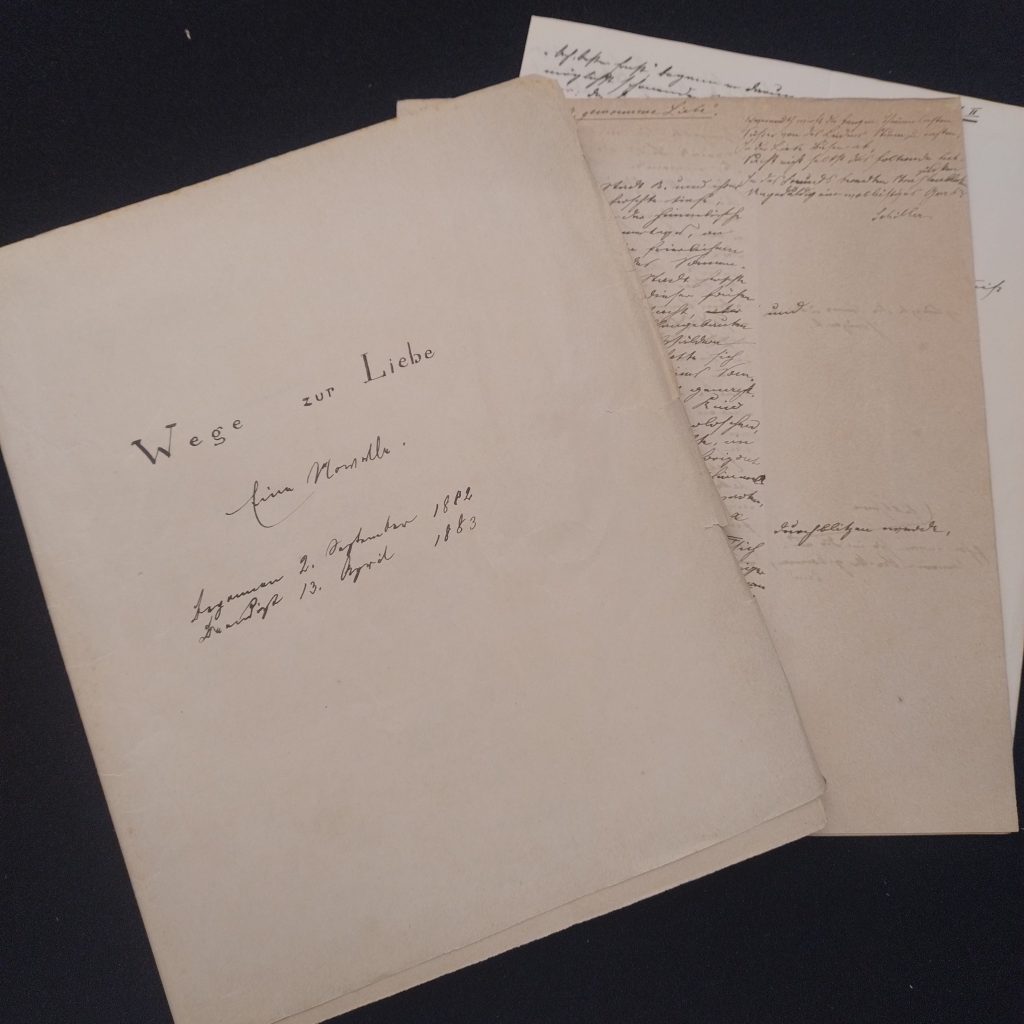
There is a certain point in a career where scholars in their role as the ideologists of their own lives even gain a few helpers along the way. Andreas Heusler III. (1865–1940), of whom you have heard in previous Finds of the Month, has spent a lifetime cultivating the self-image of the ‘artistic scholar’. His own résumé, an autobiographical text written to be read out at his own funeral, prominently suggests that he only had to take up the job as a university professor because he failed to become a writer. (3) As a matter of fact, you will be able to find a few of his early writing attempts in his estate, such as “Wege zur Liebe” (Roads to Love) or “Verlorne Freundschaft, gewonnene Liebe” (A friendship lost, a love found). Here’s an excerpt from the last text to give you an idea of Heusler’s style as a writer. Two men in their mid-twenties meet in a forest where one tries to tell the other something:
“Erst haftete er seine Augen verlegen an den Boden, mehrmals versuchte er zu sprechen, aber die Zunge, war ihm gebunden. In seinen Zügen malte sich der Kampf, welchen er mit den wild sich aufdrängenden Gedanken bestand. Sollte er sich so dem Freunde enthüllen? Geht die Grenze des Vertrauens und der Freundschaft soweit, daß nichts nur Einem verborgen, nichts nur Einem offenbar sein darf? Ernst beantwortete dies Frage seines Innern mit Ja; denn er faßte sich und fieng mit schüchterner Stimme an zu erzählen.” (At first, he cast his eyes down to the ground in embarrassment; several times he tried to speak, but his tongue was tied. His features betrayed the struggle he was waging against the thoughts that were surging wildly through his mind. Should he reveal himself to his friend in this way? Does the bond of trust and friendship extend so far that nothing should be hidden from one person alone, and nothing should be revealed to one person alone? Ernst answered this inner question with a yes; for he gathered his composure and began to speak in a timid voice.) (4)
Sadly, we won’t ever hear the rest of the story as it remains fragmentary, and we have to return to less pressing questions.
Do these texts serve as proof for Heusler’s autobiographical claim? Are they the logical starting point of his later career as an ‘artistic scholar’? Is the affected manner of the would-be writer convincing to you? For the traditional German way of writing biographical histories of our field, it probably was. For decades, there has been a strong tendency to take everything that the ‘great mind’ has uttered at face value. Younger scholars have become the old ideologist’s biographical accomplice. There are a few critical questions we can ask to counter these dynamics, though. What does the fact tell us that Heusler kept his early writings and deemed them worthy to be kept in his estate, which he knew would eventually go to a public institution? What could be learned about the practices of an archive that gave them a shelf-mark and later opened them for public access? What do we learn about a field that has chosen to celebrate Heusler’s artistic style in his scholarly work primarily to forget the unwanted political aspects therein?
I will return to the last question in a separate article, but for now, we might just ask: How do we avoid becoming the ideologist’s little biographical helpers? There are a few options, but I’ve happened to find the approach of historical epistemology quite helpful. (5) It is a way of looking at the history of scholarship that is not necessarily concerned with the facticity of or ‘the sense’ behind certain historical developments or biographical events. Rather, it examines how and under what historical conditions knowledge is produced and formalised. While doing so, this approach is constantly questioning how these histories of scholars or epistemic things are written, thereby turning the subject of the study into a moving target, blending the past into the present and vice versa. This might help us to avoid the blind spots of traditional approaches. It will probably also create other blind spots, leading to new forms of self-staging, grand narratives, and scholarly myths, even in this text. Can you spot them?
(1) Shapin, Steven and Simon Schaffer: Leviathan and the Air-Pump. Hobbes, Boyle, and the Experimental Life, Princeton: Princeton University Press, 1985, p. 6.
(2) Bourdieu Pierre: L’illusion biographique. In: Actes de la recherche en sciences sociales, Vol. 62–63, June 1986, pp. 69–72, here: p. 69. Translations in this contribution are my own.
(3) Cf. Universitätsbibliothek Basel, NL 26, 64c.
(4) Universitätsbibliothek Basel, NL 26, 65d.
(5) Cf. Hans-Jörg Rheinberger: Historische Epistemologie zur Einführung, 4. Ed., Hamburg: Junius, 2022.
Part project 5: Germanic Poetry and the Discursive Networks of Andreas Heusler III